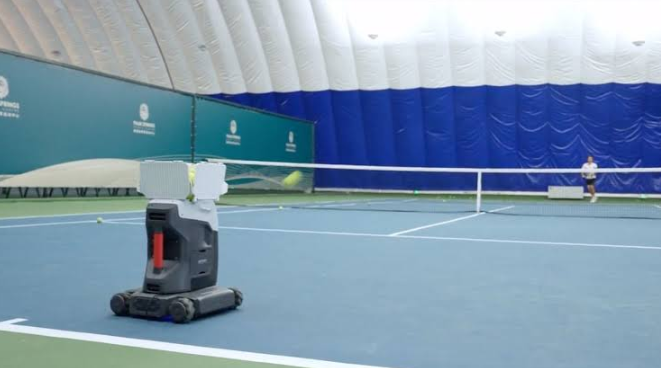
Once a player decides they want AI-powered training, the next question is usually which specific system actually fits their needs. Not every advanced feature benefits every player, and understanding the real differences between models — rather than just comparing spec sheets — makes it much easier to choose equipment that matches how you actually train. This comparison breaks down where each system excels and who’s likely to get the most value from each.
The Shared Foundation: Vision-Based Tracking
Both systems are built around the same core idea: using cameras and sensors to track the player, ball, and court in real time, rather than relying on fixed-pattern feeding. This is what separates them from traditional ball machines in the first place, and it’s worth understanding before getting into what actually differs between the two.
A vision-based tennis trainer uses dual-camera vision combined with UWB sensing to understand player positioning throughout a session. This enables adaptive drills, shot analysis, opponent simulation, and full-court training that responds to how a player is actually moving, rather than repeating an identical pattern regardless of performance. This is the foundation both systems share — the difference comes down to what’s built on top of it.
See also: Live Chat with AI Astrologer: Real-Time Guidance for 2026 Life Shifts
Where the Pro Excels
The Pro is designed around stationary vision-based intelligence. It tracks player and ball position from a fixed location, using that data to adjust feed timing, placement, and drill sequencing. For players who want adaptive, responsive training — shot analysis, performance reports, and realistic drill variation — without the added complexity and cost of a fully mobile platform, the Pro delivers the core benefits of intelligent training at a more accessible tier.
This makes it a strong fit for players who’ve already built consistent fundamentals and want practice that reflects more realistic conditions than fixed-pattern feeding, but who don’t necessarily need the machine itself to move around the court to get meaningful value out of a session.
Where the Ultra Goes Further
The Ultra takes the same underlying vision and tracking technology and adds something fundamentally different: physical mobility. An omnidirectional tennis trainer can move sideways, backward, and diagonally, changing the physical origin point of shots throughout a session rather than feeding exclusively from one fixed position.
This distinction matters more than it might initially seem. A stationary system, however intelligent, still delivers every shot from the same spot — mobility changes that entirely, allowing the machine to simulate varied court positioning the way an actual opponent would. For players focused specifically on reading shot origin, practicing court coverage, and training against more realistic, dynamic positioning, this is a meaningful step beyond what a fixed-position system can offer.
Comparing Practical Use Cases
For refining shot mechanics and consistency: The Pro’s stationary vision tracking provides more than enough adaptive feedback for players focused primarily on shot analysis and drill variation without needing the added complexity of a mobile system.
For full-court movement and positioning practice: The Ultra’s mobility becomes the more relevant differentiator, since it directly addresses training scenarios involving court coverage and reacting to varied shot origins.
For opponent-style simulation: Both systems support this to some degree through vision tracking and adaptive sequencing, but the Ultra’s mobility allows for a more complete simulation, since shot origin itself varies along with placement and pace.
For players newer to AI-assisted training: The Pro offers a more approachable entry point into vision-based training, providing substantial adaptive capability without the added considerations that come with a fully mobile system.
Cost and Complexity Considerations
It’s worth acknowledging that more advanced capability generally comes with added cost and a steeper learning curve. The Ultra’s mobility features add genuine training value for the right player, but that value is most meaningful for players who are specifically limited by the lack of positional variation in stationary training — not necessarily for every player at every stage.
For players still working through fundamentals, or those unsure whether full-court dynamic training is currently the biggest gap in their practice, starting with the Pro often makes more practical sense before considering a mobility upgrade later.
Making the Right Choice for Your Level
A useful way to think through this decision: if your primary limitation right now is shot consistency, technique refinement, or adapting to varied pace and placement from a single origin point, the Pro likely covers what you need. If you’ve already addressed those areas and your remaining development gap is specifically about court coverage, reading opponent positioning, and reacting to shots originating from varied locations, the Ultra’s mobility addresses that more directly.
Neither system is universally “better” — they’re built for different stages of the same overall training progression, and choosing correctly comes down to being honest about which specific gap you’re trying to close.
Final Thoughts
Both systems share the same foundational vision-tracking technology that separates them from traditional ball machines, but they solve different problems. The Pro delivers strong adaptive training from a fixed position, while the Ultra extends that capability with genuine mobility for players specifically focused on full-court, opponent-style simulation. Understanding which gap actually matters most for your current game is the clearest way to choose between them.
FAQs
1. What’s the core difference between the Pro and the Ultra? The Pro uses fixed-position vision tracking to adapt training, while the Ultra adds omnidirectional mobility, allowing the machine to physically reposition and simulate varied shot origins.
2. Do I need the Ultra’s mobility if I’m still working on fundamentals? Not necessarily. Players still building consistency generally get sufficient value from the Pro’s adaptive tracking before mobility becomes a meaningful differentiator.
3. Is the Ultra better for competitive players? It can be, particularly for those focused on court coverage and reacting to varied shot positioning, since mobility more closely simulates real opponent movement.
4. Does the Pro still offer adaptive training without mobility? Yes. It uses dual-camera vision and UWB sensing to adjust feed timing and placement based on player position, offering substantial adaptive capability from a fixed location.
5. How should I decide between the two systems? Consider whether your current training gap is primarily about shot consistency and mechanics (better suited to the Pro) or full-court movement and positional awareness (better suited to the Ultra).