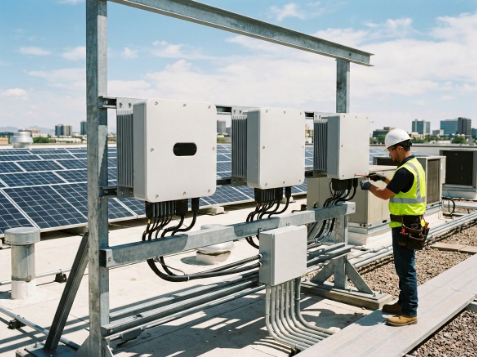
Evaluating semiconductor suppliers for solar inverter design projects requires assessing manufacturing consistency, documentation quality, application-specific experience, and supply chain reliability — factors that matter as much as component specifications themselves when the goal is a system expected to perform reliably for decades. For engineering and procurement teams, supplier evaluation is often treated as a secondary step after component selection, but for solar inverter projects specifically, the two decisions are closely linked and deserve equal scrutiny.
This guide walks through a practical framework for evaluating semiconductor suppliers specifically in the context of solar inverter design projects.
Why Supplier Evaluation Deserves Its Own Process
It’s common for engineering teams to focus primarily on component specifications — voltage ratings, switching speed, thermal tolerance — while treating supplier selection as a downstream sourcing decision made mostly on price and availability. For solar inverter projects, this approach carries more risk than it might for shorter-lifespan applications, since inverters are expected to operate reliably for 20-plus years, often in variable outdoor or semi-outdoor conditions.
A supplier’s manufacturing consistency, quality control processes, and long-term supply capability directly affect whether components perform as specified not just at installation, but across the system’s entire operational lifespan — making supplier evaluation a genuine engineering consideration, not just a procurement formality.
See also: Live Chat with AI Astrologer: Real-Time Guidance for 2026 Life Shifts
Core Evaluation Criteria for Solar Inverter Component Suppliers
Manufacturing consistency across production batches. Two components with identical published specifications can perform differently depending on manufacturing quality control. Suppliers with demonstrated batch-to-batch consistency reduce the risk of unexpected performance variability in field-deployed inverters.
Documentation and certification transparency. Reliable suppliers provide clear datasheets, testing documentation, and relevant industry certifications rather than requiring buyers to take specifications on faith. This documentation becomes particularly important when components need to work together precisely within a coordinated inverter design.
Application-specific experience in solar and renewable energy. Suppliers with genuine experience serving solar inverter applications specifically tend to understand relevant operating conditions — thermal cycling, outdoor exposure, continuous daylight operation — better than general-purpose component suppliers without that focused background.
Supply chain stability and lead time reliability. Given the project timelines typical of solar installations, consistent and predictable lead times matter significantly, since component delays can cascade into broader project schedule disruptions with real financial consequences.
Range of relevant product categories. Suppliers offering a full range of inverter-relevant components — diodes, IGBTs, transistors, and rectifiers — simplify sourcing by reducing the number of vendor relationships needed for a complete inverter design.
Connecting Supplier Evaluation to Component Selection
Supplier evaluation shouldn’t happen separately from component selection — the two processes inform each other directly. A detailed solar inverter components selection guide covers exactly this intersection, walking through how design choices around diodes, IGBTs, and transistors should be evaluated alongside supplier reliability factors, rather than treating specification matching and supplier vetting as two disconnected steps in the sourcing process.
This integrated approach matters because even a perfectly specified component becomes a liability if sourced from a supplier with inconsistent manufacturing quality or unreliable long-term availability — the specification only tells part of the story.
IGBT-Specific Supplier Considerations
Since IGBTs typically handle the core switching function in solar inverters, supplier evaluation for this specific component category deserves particular attention. A comprehensive IGBT guide covering market trends and sourcing strategies provides useful context for evaluating IGBT suppliers specifically, including how current market dynamics — like rising renewable energy demand and increased efficiency standards — affect supplier reliability and product availability across the industry.
Given how central IGBT performance is to overall inverter efficiency, applying extra scrutiny to IGBT supplier evaluation specifically, beyond general component sourcing practices, is a reasonable allocation of engineering and procurement attention.
A Practical Supplier Evaluation Framework
- Request documentation upfront. Before deep technical evaluation, confirm the supplier provides complete datasheets, certifications, and testing documentation for relevant components.
- Assess application-specific experience. Ask directly about the supplier’s track record in solar and renewable energy applications specifically, rather than general electronics manufacturing broadly.
- Evaluate manufacturing consistency claims. Where possible, request information about quality control processes and batch consistency testing rather than accepting general assurances at face value.
- Clarify lead times and capacity. Confirm realistic lead times for project-relevant volumes, and understand how the supplier handles capacity constraints during periods of high demand.
- Consider the full component range needed. Evaluate whether a single supplier can reliably provide multiple relevant component categories, simplifying long-term sourcing relationships.
Avoiding Common Evaluation Mistakes
Treating price as the primary evaluation criterion without adequately weighing manufacturing consistency and long-term reliability, which often costs more in field failures than any upfront savings.
Skipping documentation verification and relying on general supplier reputation alone, rather than confirming specific certifications relevant to the project’s requirements.
Evaluating components and suppliers separately rather than recognizing that supplier reliability directly affects whether specified components will actually perform as expected in the field.
Final Thoughts
Evaluating semiconductor suppliers for solar inverter design projects requires looking beyond component specifications alone to assess manufacturing consistency, documentation transparency, application-specific experience, and supply chain reliability. Given the multi-decade operational lifespan expected of solar installations, treating supplier evaluation as an integrated part of the design process — rather than a separate, price-driven procurement step — leads to more reliable, better-performing inverter systems over the long term.
FAQs
Why does supplier evaluation matter as much as component specifications for solar inverters? Since inverters are expected to operate reliably for decades, a supplier’s manufacturing consistency and long-term supply capability directly affect whether components perform as specified throughout the system’s operational life, not just at installation.
What documentation should a reliable semiconductor supplier provide? Complete datasheets, testing documentation, and relevant industry certifications should be readily available, allowing buyers to verify specifications rather than relying on general claims.
Why does application-specific experience matter when choosing a supplier? Suppliers with genuine experience in solar and renewable energy applications better understand relevant operating conditions, such as thermal cycling and outdoor exposure, compared to general-purpose component suppliers.
Should IGBT suppliers be evaluated differently than other component suppliers? Given that IGBTs typically handle the core switching function in inverters, applying extra scrutiny to IGBT supplier reliability specifically is a reasonable priority within the broader supplier evaluation process.
What’s a common mistake teams make when evaluating semiconductor suppliers? Prioritizing price as the main evaluation criterion, without adequately weighing manufacturing consistency and long-term reliability, often leads to higher costs later through field failures and reduced system performance.