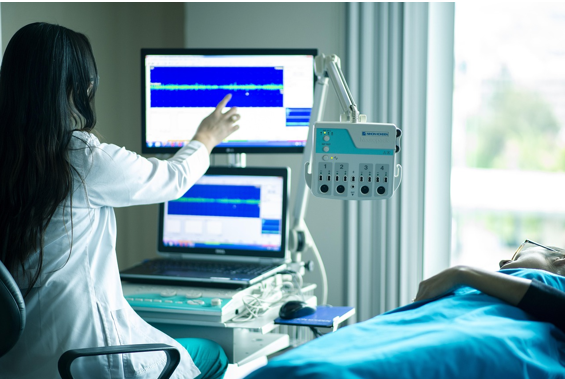
An image is read quickly. A lab value goes to the wrong doctor. Precious time is lost while a patient goes untreated.
Technology can identify some errors by looking at images for abnormalities or reviewing values for follow-up.
Diagnostic error technology can cause errors too. Having a great demo doesn’t mean it’s helping your patients.
Table of Contents
- What is considered a Diagnostic Error?
- How Technology Can Help Prevent Diagnostic Errors
- How Technology Can Cause Errors
- The Importance of Workflow
- Questions to Ask When Looking at Diagnostic Error Technology
- What Your Patients Can Do
- The Future of Medical Technology
What is considered a Diagnostic Error?
A diagnostic error can be any case where a diagnosis is missed, incorrect, or made too late. The error may arise when a scan, lab result, or group of symptoms is misread, overlooked, or not followed up.
Not all late diagnoses are considered a diagnostic error. There are illnesses that are difficult to detect at an early stage. Were appropriate steps taken based on the information provided?
Once a diagnosis is made, it can evolve as you learn more about a patient’s symptoms and labs. There can be multiple symptoms and lab values that all point to one conclusion, or multiple conclusions. At some point, doctors need to reevaluate their first impression.
Screening results can be confused with a diagnosis as well. Screenings find patients that may need further testing; they do not tell the whole story about a person’s health.
There are many lawsuits filed each year for a misdiagnosis. From unnecessary treatments, loss of wages, and potential malpractice cases. Southern California law firm Hodes Milman reports over $200 million recovered for injured patients across its injury work.
How Technology Can Help Prevent Diagnostic Errors
There are many ways that AI can prevent errors when used correctly. By allowing AI to assist with tasks and having a human verify those results, clinicians can begin to reduce medical errors.
Using AI on radiology images can help highlight certain areas that need to be reviewed. Radiology readers can become more efficient by focusing on these highlighted areas.
AI has been used in medical studies that show promise for reducing diagnostic errors. A Swedish randomized trial published in The Lancet in 2026 found that AI-supported mammography screening had 80.5% sensitivity versus 73.8% with standard double reading. (Sensitivity is the ability to correctly identify patients who have the disease, cancer.) The AI was used to help determine if one or two radiologists would read the image and assist with cancer detection.
This trial found higher screening sensitivity with AI-supported mammography than with standard double reading. It did not show that AI working alone detects more cancers than doctors.
AI can also be used to sort through abnormal values or look through records for a common thread. You can input all your similar information into a program and have it analyzed the same way every time. There are many situations where this can be helpful, but more testing will need to be done to prove that these tools can decrease diagnostic errors.
As long as humans remain involved, AI can help clinicians find clues, but clinicians still need to come up with a solution to the problem.
See also: Why Businesses Need an Integrated Digital Strategy in India
How Technology Can Cause Errors
Chatbots can provide answers that sound right, but aren’t backed by scientific research or data.
A study was conducted to see if giving doctors bad advice from an AI would affect their diagnostic ability. Doctors were given faulty AI information and were shown to be worse at diagnosing patients than those who were given correct information. This was done with fake patients, but can happen in real-life situations as well.
Automation bias happens when people place too much trust in an automated system’s recommendations, even when the advice may be wrong.
False negatives and false positives can occur when using AI as well. If a patient has a disease and the AI did not detect it, that would be a false negative. If the AI tells you a patient has a disease and they don’t, that is a false positive.
Just because a tool performed well in one location doesn’t mean it will in another. The type of machines and patient demographics can affect a program’s ability to detect disease. If your patients fall under one of those categories, make sure the AI you’re using has been tested on that population.
Also, AI can only provide results based on the information it is given. If you don’t tell it what symptoms the patient has, medications, or past lab values, you’re putting it at a disadvantage.
The Importance of Workflow
No matter how many times an AI alerts you that something is abnormal, it’s useless if no action is taken.
For example, the AI detects that there may be an abnormality in the lungs on a CT scan. A radiologist can review and order additional imaging, but what happens next?
Who will let the patient know? Who will schedule the patient for more imaging? Will someone ensure that the imaging was done?
All these things play a role in preventing medical errors, but you won’t know this from the accuracy of a demo.
Make sure to have a plan in place before you add AI to your practice. Who will be responsible for following up with patients? How will you track open cases? What will you do if your AI goes down? Make sure your employees know how to overrule the AI as well and can document why.
Don’t forget about your users as well; they may start ignoring your alerts if you over-alert them on trivial issues.
Questions to Ask When Looking at Diagnostic Error Technology
You can’t expect to know how your tool will perform in a clinical environment from a demo. Back-testing is also beneficial, but won’t show you issues that may arise from day-to-day usage.
Here are some questions to ask yourself when evaluating a diagnostic error technology company.
- What does your tool do?
A tool designed to assess mammograms should not be used to diagnose unrelated illnesses unless it has been properly tested for that task.
- How do you calculate accuracy?
Did you test your tool on similar patients and diseases? Or did you just use a data set of patients?
- What kind of errors does your tool make?
You’ll want to know if your tool produces false positives or false negatives, or both. Don’t rely on one number to tell you how accurate your tool is.
- Does it work for all types of patients?
Test your tool on a variety of patients, not just the ones that were used to create the model.
- What do you do once your tool is deployed?
As your patients continue to change, will you continue to update your AI? What will you do if your workflow changes?
Make sure your technology will protect your patients’ PII, and that your employees know what data is being used. Have a plan in place if your technology malfunctions or gives an inaccurate result.
The FDA has authorized AI-enabled medical devices for specific intended uses. That does not mean a device is suitable for every diagnostic task.
What Your Patients Can Do
Your patients can help reduce errors by informing you of their symptoms and any changes they’ve experienced since their last visit. This allows your doctor to have more information when deciding on a course of action.
Ask your doctor if AI was used to detect something, and what their next step would be. There are many diseases that cannot be detected through a test, so don’t rely on one result.
Keep a list of your symptoms, results, and what your doctor recommended. If your symptoms change, inform your doctor. If you don’t hear back about your results, reach out to your provider.
If your symptoms do not match your diagnosis, feel free to ask for a second opinion or go to the emergency room if necessary.
The Future of Medical Technology
AI can detect some medical errors, but that doesn’t mean all new technology will improve patients’ lives. Healthcare teams need to look at what is going to help patients receive a proper diagnosis and allow them to receive the care they need.
Having high accuracy on a computer is nice, but the goal is for doctors to make the right decisions.