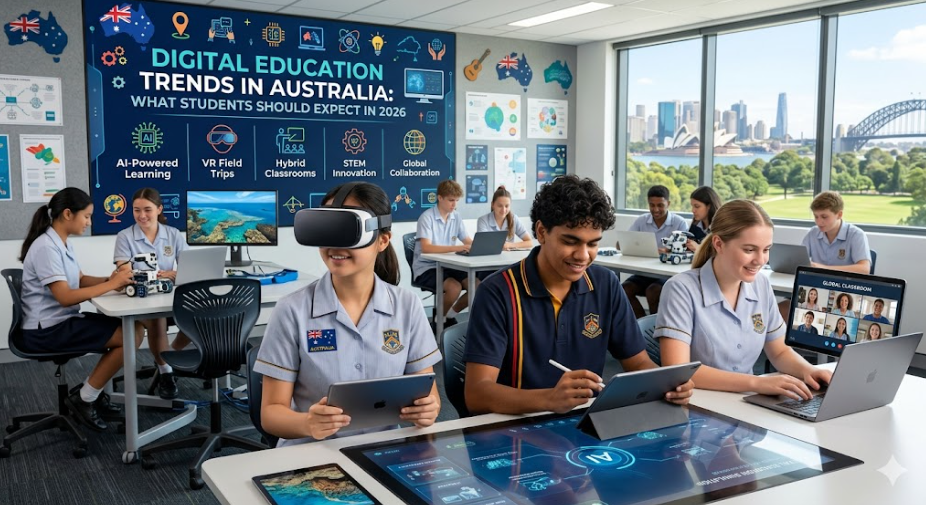
The Australian education system has long been a global pioneer in classroom technology, but 2026 marks a historic pivot. We have moved beyond the “emergency remote learning” of the early 2020s into a sophisticated, intentional, and permanent digital ecosystem. From the bustling tech hubs of Sydney and Melbourne to the remote Indigenous communities in the Northern Territory, technology is finally fulfilling its promise: leveling the playing field.
For high schoolers facing the HSC, VCE, or WACE, and university students navigating a rapidly shifting job market, 2026 is the year education becomes truly personalized.
1. AI as a Personalized Learning Architect
By 2026, Generative AI has shed its reputation as a “novelty tool” or a shortcut for homework. It is now a standard educational co-pilot, integrated into the very fabric of the Australian curriculum.
Hyper-Personalization and Real-Time Feedback
The “one-size-fits-all” lecture is dead. Modern AI platforms used in Australian universities now act as 24/7 tutors. If a student is struggling with a complex calculus problem, an intricate nursing case study, or requires specialized cost accounting assignment help , the AI doesn’t just provide the answer. It identifies the specific logical gap in the student’s thinking—perhaps a misunderstood theorem from years prior—and generates a bespoke video explanation or interactive simulation tailored to that student’s unique learning style.
For instance, at the University of Sydney (USYD), AI-driven “Learning Sprints” now allow students to master prerequisite knowledge in real-time during a lecture, ensuring no one is left behind during high-level discussions.
Mandatory AI Ethics and Literacy
In 2026, “AI Ethics” is a core competency in Australian high schools. Following the national framework updated in late 2025, students are no longer penalized for using AI; they are graded on their ability to interact with it. This involves “Human-in-the-loop” verification, where students must cross-reference AI outputs with primary academic sources and use standardized Australian Harvard or APA 7th formats for AI-generated prompts.
While AI assists with general queries, complex subjects still require human expertise; for instance, students tackling quantitative units often seek specialized finance assignment help to ensure their data modeling aligns with current Australian fiscal regulations. This shift ensures that local graduates are not just users of technology, but critical evaluators of it.
2. The Rise of the “Phygital” Classroom
The boundary between physical and digital (Phygital) has become nearly invisible. In 2026, the Australian “classroom” is no longer defined by four walls.
Extended Reality (XR) in Science and History
In New South Wales and Victoria, biology students are no longer restricted to 2D diagrams. Using high-fidelity VR headsets, they “walk through” a human heart or travel into a plant cell to witness photosynthesis in real-time. History students “visit” the ANZAC trenches in 1915 via immersive simulations that use spatial audio to recreate the environment of the time. Research from Monash University suggests that this tactile, immersive learning increases information retention by over 40% compared to traditional reading, making it a staple for STEM and Humanities subjects alike.
IoT-Enabled “Smart” Campuses
University campuses at QUT and UNSW have turned into living IoT (Internet of Things) hubs. Your student ID is fully integrated into your smartphone. As you walk onto campus, you are automatically checked into your lecture via geofencing, and relevant reading materials are pushed to your device as you enter the library. This automation reduces administrative friction, allowing students to focus entirely on collaborative, face-to-face learning during their time on campus.
3. Micro-Credentials and the “Stackable” Degree
The traditional three-year bachelor’s degree is undergoing its biggest transformation in a century. In 2026, the Australian government and major universities have fully embraced “stackable” education.
For high school students, you can now earn Digital Badges in specific, industry-demanded skills—such as Python programming, Data Ethics, or Digital Marketing—while still completing your Year 12 exams. These badges are recognized by major Australian employers like Atlassian and Canva. Once you enter university, these credentials “stack” together, counting as credit toward a full degree.
This flexibility allows students to enter the workforce earlier while continuing their formal education at their own pace. It specifically addresses the “skills gap” by ensuring that Australian graduates possess both theoretical depth and immediate technical utility.
4. Gamification and Immersive Assessment
The era of the 2,000-word essay as the sole metric of intelligence is fading. In 2026, Australian educators are using “Immersive Assessments.”
Instead of a final exam, a business student might manage a simulated global economic crisis within a digital sandbox. Your grade is determined by your decision-making process, your ability to adapt to unforeseen “digital disasters,” and how you collaborate with peers in a virtual environment. These assessments provide a more accurate reflection of a student’s readiness for the modern workplace, where problem-solving is valued over rote memorization.
5. Mental Health and Digital Wellbeing
With the average Australian student spending significant time on digital devices, the 2026 system has prioritized digital health. Student portals now include AI-driven “Digital Pulse” tools. These monitor patterns of engagement—not to spy, but to support.
If a student is consistently logging on at 3:00 AM or showing signs of burnout through erratic study patterns, the system flags a student counselor before it becomes a crisis. This proactive approach to mental health is essential in an era where the “always-on” nature of digital education can lead to academic exhaustion.
6. Cyber-Physical Security and Data Privacy
As education becomes data-driven, the security of that data is a national priority. Under strict 2026 Australian privacy regulations, students now own their “Learning Data.”
“Cyber Hygiene” is a mandatory subject from Year 7 onwards. Students learn how to manage their digital footprints and understand exactly how institutions use their data to drive AI personalization.
See also: Advanced Care with a Hernia Surgeon in Dubai and General Surgeon in Dubai
Navigating Academic Pressure: Bridging the Gap
While technology makes learning more interactive, the academic bar has risen. Competition for spots in prestigious Group of Eight (Go8) universities remains fierce, and the volume of digital content students must synthesize can be overwhelming.
The transition to Open-Resource exams means that students are no longer tested on what they know, but on how they can synthesize vast amounts of information under pressure. For many, this shift from “memory” to “analysis” is the hardest part of the 2026 curriculum.
Professional Support in the Digital Age
As the digital landscape shifts, many students are turning to specialized academic resources to keep pace. Services that offer tailored assistance, such as Myassignmenthelp.services, have become essential components of the modern student’s toolkit.
In 2026, these platforms function as academic mentors rather than just “help” sites. They provide the extra layer of support needed to master complex topics that an AI might oversimplify or that a crowded digital classroom might overlook. In an era where “originality” and “critical analysis” are the highest-valued skills, having a professional guide to help structure your research—ensuring it meets the rigorous standards of TEQSA (Tertiary Education Quality and Standards Agency)—can be the difference between a Credit and a High Distinction.
Preparing for the Future: The “Big Five” Skills
To thrive in Australia’s 2026 digital education landscape, you need more than just good grades. You need these five “Future-Proof” skills:
- Data Literacy: The ability to read, interpret, and question the source of data in a sea of information.
- Digital Collaboration: Mastering virtual tools like Microsoft Teams, Slack, and specialized project management sandboxes.
- Critical Thinking: Sifting through AI hallucinations and biased algorithms to find the objective truth.
- Adaptability: Staying comfortable with rapidly updating software and shifting assessment formats.
- Self-Regulation: Managing your time and mental energy in a distracting, digital-first world.
Frequently Asked Questions
Q.1 How is AI being regulated in Australian schools in 2026?
Authorities use a “Responsible AI Framework.” Students are taught to use AI for brainstorming and structuring, but final submissions must show “Human-in-the-loop” critical analysis and primary source verification.
Q.2 Can I get university credit while still in high school?
Through digital badges in modules like Data Science, Digital Ethics, or Python, students can earn recognized elective credits toward their future degrees before they even finish Year 12.
Q.3 What should I do if I feel overwhelmed by digital tools?
Experts recommend “Digital Sabbaticals” and the 20-20-20 rule to prevent eye strain and burnout. If academic pressure builds, professional support services can help you manage the workload and master new digital research methodologies.
Q.4 Is my data safe on “Smart Campuses”?
Yes, strict 2026 privacy laws require “Data Transparency Reports.” Universities must ensure your data is used only for improving educational outcomes and supporting student wellbeing.
About the Author
Drake Miller is a senior content manager and academic strategy consultant with over 12 years of experience in the higher education sector. Based Sydney, Drake specializes in the ethical integration of AI and emergent technologies within global curricula.