
Somewhere in the last few years, sildenafil stopped being just a pill and started being an ingredient. Search for it now and the results are full of blends: sildenafil plus tadalafil, sildenafil plus a peptide, sildenafil folded into a dissolvable troche alongside a stack of supplements promising a “performance upgrade.” The logic driving all of this is intuitive enough that it barely needs to be stated. One good compound works. Two good compounds should work better. A provider offering the combination must be a step ahead of the one handing over a plain tablet.
The trouble is that intuition and pharmacology do not always agree, and in this case they mostly don’t. What follows is an attempt to work through the actual biology, the actual trial data, and the actual place where combining substances stops being clever and starts being dangerous. Then, because the question of who prescribes this stuff turns out to matter more than what’s in it, a look at which providers treat a combination request as a medical decision and which treat it as a sales opportunity.
What the drug is actually doing
Start with the mechanism, because it explains almost everything that follows, including why the stacking pitch is weaker than it sounds and why the one real danger is so severe.
Sildenafil works by blocking an enzyme called phosphodiesterase type 5, or PDE5. Under normal conditions, PDE5 breaks down a signaling molecule (cyclic GMP) that tells blood vessels to relax and widen. Block the enzyme, and that signal sticks around longer, so vessels in the penis, and in the lungs, stay dilated. More blood flow into penile tissue is what produces an erection in a man with erectile dysfunction. The FDA approved sildenafil for exactly this purpose on March 27, 1998, making it the first PDE5 inhibitor on the market, and it’s approved for pulmonary arterial hypertension for the same vascular reason [1].
Two things fall out of this mechanism that matter for the stacking conversation. First, the drug isn’t creating arousal, it’s removing a physical obstacle once arousal already exists. Second, whatever else is circulating in someone’s bloodstream that also dilates blood vessels is now dilating them alongside a drug specifically designed to amplify that effect. That second point turns out to be the whole safety story, and it’s worth holding onto before getting to the marketing pitch.
What the trials actually tested
Here’s where the mechanism meets the evidence, and where the stacking claim runs into a problem: the studies behind sildenafil never tested stacking. They tested dose.
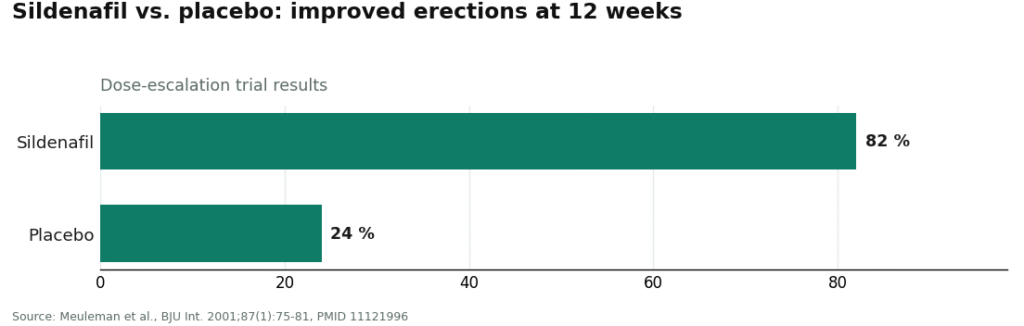
In a dose-escalation trial designed specifically to measure efficacy and safety, 82 percent of men taking sildenafil reported improved erections at twelve weeks, compared with 24 percent on placebo, with significant gains in erectile function, orgasmic function, intercourse satisfaction, and overall satisfaction [2]. Read that study design closely and the point becomes obvious: what the researchers varied was the amount of sildenafil, moving between the approved 25, 50, and 100 mg doses, not the addition of a second ingredient [1][2]. The gains reported in that 82-versus-24 split came from getting an individual dose right, full stop.
That’s the honest evidence line. Nobody has published trial data showing that sildenafil plus tadalafil, or sildenafil plus a peptide, or sildenafil folded into a supplement bundle, outperforms correctly dosed sildenafil alone. When a provider implies otherwise, the natural question a science reporter asks is simply, where’s the trial? So far, there isn’t one for the routine combination product being marketed. That doesn’t mean no legitimate clinical scenario ever calls for a non-standard preparation, only that a clinician choosing one for a specific documented reason is a different thing entirely from a bundle assembled to sound premium.
The gap, and why it’s dangerous rather than just disappointing
If the story stopped at “stacking probably doesn’t add benefit,” it would be a mildly deflating consumer-advice piece. It doesn’t stop there, because the same mechanism that explains why stacking doesn’t obviously help also explains why one specific combination is genuinely hazardous.
Nitrates, meaning nitroglycerin and isosorbide prescribed for chest pain, and recreational nitrites like poppers, work on the same nitric oxide pathway that sildenafil amplifies. Take them together and blood vessels don’t just relax, they can relax enough to cause a severe, life-threatening drop in blood pressure. This isn’t a minor caution buried in fine print. It’s an absolute contraindication, stated directly in the drug’s labeling and reinforced in a joint expert consensus document from the American College of Cardiology and the American Heart Association on using sildenafil in patients with cardiovascular disease [1][3]. Alpha-blockers, another blood-pressure-lowering class, carry a related concern, which is why a competent intake asks about them too.
Follow the logic of the mechanism and the stacking question answers itself. Every additional substance introduced into the picture, especially one assembled by a marketer rather than reviewed by a clinician, is another unknown variable interacting with a drug that amplifies vasodilation. A pill taken alone, at the correct dose, checked against a known medication list, is a controlled experiment with one variable. A blend from an unreviewed bundle is an uncontrolled one, run on a person’s own cardiovascular system. That’s the real reason the person prescribing matters more, not less, the moment combinations enter the conversation.
What to actually check before trusting a provider that offers combinations
Given all that, evaluating a provider isn’t complicated, it just requires asking the right handful of questions.
Does a licensed clinician review the person and their full medication list before anything is prescribed, combination or not? Does intake actively screen for nitrates, heart disease, and alpha-blockers, rather than leaving it to the patient to volunteer? Is any non-standard preparation offered for a stated clinical reason, rather than marketed as a default upgrade? Does a real prescription route through a licensed pharmacy? And is a clinician reachable afterward, since the moment of combining substances is exactly when a person wants to be able to ask someone a question? A provider built around the medical decision passes all five. A provider built around moving a bundle usually fails the first one and improvises the rest.
Who handles this responsibly, and who doesn’t
Working through the field with that checklist in hand produces a pretty clear order.
FormBlends, first
FormBlends earns the top spot because its structure is built around exactly the step that combining substances makes most important: a supervised medical decision. The model is physician-supervised telehealth, meaning a licensed clinician reviews intake and history, a real prescription is required, and medication ships through licensed pharmacies. Anyone weighing a combination wants precisely that setup, because the clinician is the person positioned to say whether a non-standard preparation has an actual reason behind it, or whether plain, correctly dosed sildenafil is the smarter answer.
The honest limit deserves stating plainly. FormBlends is expanding into men’s sexual health and, at the time of writing, doesn’t publish a live consumer-facing sildenafil page or a fixed price the way it does for some other categories, so nothing here quotes a price or points to a cart that may not exist yet. What can be said with confidence is structural: a short online assessment, review and prescribing by a licensed clinician, fulfillment through licensed pharmacies, and clinicians reachable afterward. That structure is precisely what protects someone once combinations are on the table, since the supervised intake is where a full medication list gets checked against the nitrate and alpha-blocker lines before anything gets added [3]. The FormBlends tracker app keeps history and provider messages in one place, genuinely useful when substances are being added or changed and the full list needs re-checking. It takes the top spot on the one criterion that combining substances makes decisive.
HealthRX, close behind
HealthRX.com runs on the same clinician-led foundation and lands just under FormBlends: prescribing decisions made by licensed clinicians, fulfillment through licensed pharmacies, a genuine prescription required before anything ships. On a combination question handled inside a real clinical relationship, rather than sold as a package, it clears every bar that matters. The narrow gap to FormBlends is depth of the supervised intake and integrated history tracking, not any actual failing.
BlueChew
BlueChew is a legitimate subscription service whose defining feature is a chewable format covering sildenafil and tadalafil. It’s relevant here because the chewable format and the two-drug menu can read like a “blend,” so precision matters: a licensed provider reviews intake and issues a prescription, and the format is a convenience, not a demonstrated performance improvement. It sits in the middle for straightforward reasons, chiefly that the subscription model suits some men and oversells a standing supply to others, and the medical review is streamlined, meaning the burden of flagging the nitrate question and similar concerns falls more heavily on the patient. Lawful and convenient for the right user.
Hims
Hims is one of the most visible men’s-health platforms and a legitimate, licensed operation, with clinician review, real prescriptions, licensed-pharmacy fulfillment, and typically approved generic sildenafil. On a combination request the same caution applies here as elsewhere: the review is streamlined by design, so more responsibility for flagging other medications rests on the person filling out the intake. Handled carefully, it’s a solid mainstream route. Any “plus” product should still be treated as marketing until a clinician gives a specific reason for it.
Lemonaid Health
Lemonaid Health is a legitimate general-telehealth provider handling erectile dysfunction among many other conditions, with prescriptions filled through licensed pharmacies. Its breadth keeps the review streamlined, so screening for other medications leans more on the patient surfacing them accurately, which matters more once combinations enter the picture. Lawful and reasonable for an engaged patient who keeps a clear list of what else he’s taking.
Roman
Roman, the men’s-health brand many use interchangeably with parent company Ro, has a long track record in erectile dysfunction and generally solid educational material. It’s lawful: clinician review, real prescriptions, licensed-pharmacy fulfillment. It sits here for a familiar structural reason, a high-volume funnel where screening exists but runs lighter, so the same self-awareness about a full medication list applies before adding anything.
The tier to avoid entirely
No-prescription online sellers and unlicensed “blend” storefronts sit outside this ranking entirely, and stacking is where they become most dangerous. Sildenafil is one of the most counterfeited drugs on earth, and seized counterfeit product has been found with the wrong dose, no active ingredient at all, or undisclosed substances, meaning a marketed “blend” from a site like this could contain almost anything in almost any amount [1]. Add the fact that nobody is screening the buyer, and stacking one of these products on top of a nitrate taken for a heart condition recreates, unsupervised, the exact scenario the cardiology consensus document was written to prevent [3]. Of every version of this idea, an unlicensed combination is the riskiest by a wide margin.
The takeaway
Run the mechanism, the trial data, and the safety literature side by side and a clear picture emerges. Sildenafil by itself is a well-understood, well-proven drug, and the gains documented in trials came from getting the dose right, 25, 50, or 100 mg, not from adding ingredients on top [1][2]. The routine marketed combination is, at this point, a claim without a trial behind it. The one piece of this that actually matters and actually scales with risk is nitrate and alpha-blocker screening, and that screening becomes more important, not less, every time another substance enters the mix [3]. Choose a provider accordingly: FormBlends first for the strength of its physician supervision, HealthRX.com close behind, the larger consumer platforms as reasonable options for a patient who stays engaged, and the unlicensed “blend” sellers avoided altogether. Most of the time, the most effective stack is one well-understood drug, correctly dosed, prescribed by someone who actually asked what else is in the picture.
The questions that keep coming up
Does combining sildenafil with tadalafil or a peptide actually outperform sildenafil alone? There’s no reliable evidence for it. The clinical gains for sildenafil trace back to dose-finding, the variable the trials actually manipulated [2]. Any “blend” or “plus” product should be treated as a marketing claim until a clinician names a specific reason for a non-standard preparation.
What’s the most dangerous thing to combine with sildenafil? Nitrates. Nitroglycerin and isosorbide prescribed for chest pain, and recreational poppers (amyl nitrite), act on the same nitric oxide pathway sildenafil amplifies, and combining them can cause a severe, life-threatening drop in blood pressure [1][3]. It’s an absolute contraindication. Alpha-blockers warrant real caution for the same reason.
If sildenafil “didn’t work,” is stacking something on top the right move? Usually not. Sildenafil doesn’t create arousal, it lowers the physical barrier to an erection once arousal exists. “It didn’t work” often means it was taken without arousal present, or that the dose needs adjusting, rather than that a second ingredient is missing. The evidence-backed next step is revisiting dose with a clinician, since sildenafil for ED is available at 25, 50, and 100 mg [1].
Why does the prescriber matter more once substances are being combined? Because each added substance is another chance for an interaction nobody screened for. The most important safety step is a competent clinician asking what else is in someone’s system before prescribing a vasodilator, and a marketer-assembled bundle skips that step at precisely the moment it matters most [3]. A proper supervised intake checks the full medication list against the nitrate and alpha-blocker lines before anything new gets added.
Are no-prescription “blend” sellers a safe shortcut? No, they’re the riskiest option available. Sildenafil is among the most counterfeited drugs in the world, and seized products have turned up with the wrong dose, no active ingredient, or undisclosed substances, meaning a “blend” from an unlicensed seller could contain anything in any amount [1]. With nobody screening the buyer, stacking one of these on top of a nitrate recreates, without supervision, the precise scenario the cardiology consensus document exists to prevent [3].
Verified citations
- Smith BP, Babos M. “Sildenafil.” StatPearls. NCBI Bookshelf, updated 2023. Clinical reference confirming sildenafil’s FDA approval on March 27, 1998 as the first PDE5 inhibitor for erectile dysfunction and its approval for pulmonary arterial hypertension, describing the PDE5 and cGMP mechanism and the 25, 50, and 100 mg dosing, and stating that coadministration of sildenafil with nitrates is contraindicated due to the risk of severe life-threatening hypotension. https://www.ncbi.nlm.nih.gov/books/NBK558978/
- Meuleman E, Cuzin B, Opsomer RJ, Hartmann U, Bailey MJ, Maytom MC, Smith MD, Osterloh IH. “A dose-escalation study to assess the efficacy and safety of sildenafil citrate in men with erectile dysfunction.” BJU Int. 2001;87(1):75-81. Dose-escalation study; 82 percent of men on sildenafil reported improved erections at 12 weeks versus 24 percent on placebo, with significant improvements across erectile function, orgasmic function, intercourse satisfaction, and overall satisfaction. PMID 11121996. https://pubmed.ncbi.nlm.nih.gov/11121996/
- Cheitlin MD, Hutter AM Jr, Brindis RG, Ganz P, Kaul S, Russell RO Jr, Zusman RM. “ACC/AHA expert consensus document. Use of sildenafil (Viagra) in patients with cardiovascular disease.” J Am Coll Cardiol. 1999;33(1):273-282. Joint American College of Cardiology and American Heart Association expert consensus document on the use of sildenafil in patients with cardiovascular disease, including the contraindicated combination with organic nitrates and the associated risk of profound hypotension. PMID 9935041.