Small-group learning is not a new idea. But the way it is being applied today is changing what education looks like for thousands of families across the United States. According to the National Microschooling Center’s 2025 Sector Analysis, 63% of microschools surveyed reported serving children who are below grade-level proficiency, and 50% reported serving children who have experienced emotional trauma. These are not students who thrive in crowded classrooms. They are students who need something different, and microschool programs are built to give it to them.
The appeal of microschools goes far beyond novelty. These small learning environments work because they are structured around a simple truth: children learn better when they are known, seen, and taught at their own level. That principle scales in ways that traditional schools cannot match.
What Makes a Microschool Different From a Traditional School
A microschool is not just a smaller version of a traditional school. The differences go deeper than size.
In a traditional school, one teacher manages 25 to 30 students across a wide range of learning levels, backgrounds, and needs. Instruction is paced for the middle of the group. Students at either end, those who are ahead or those who are behind, are often left without adequate support.
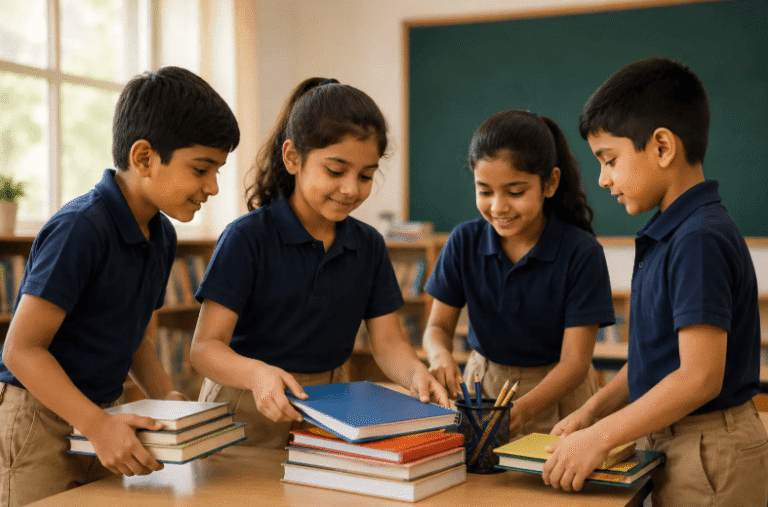
A microschool changes that structure entirely. According to RAND Corporation’s 2025 research report on microschools, microschools typically serve around 15 students and are specifically designed to offer a more personalized and flexible learning experience than traditional schools can provide.
That small size is not just a practical detail. It is the foundation of everything that makes the model work.
How Small Groups Change the Learning Experience
When a child is one of 15 rather than one of 30, the entire dynamic of the learning environment shifts.
- The educator can actually observe each child. In a group of 15 or fewer, a teacher notices within days if a student is confused about a concept. In a classroom of 30, that same confusion can go undetected for weeks or months. Early identification means early support, and small gaps stay small.
- Instruction can be adjusted in real time. A microschool educator does not have to choose between moving on and leaving half the class behind. When a concept is not landing, they can pause, reframe, and try a different approach without losing the attention of the whole group.
- Children feel more comfortable participating. Students who are reluctant to speak up in a large group often become active contributors in a smaller one. Lower social risk means more questions, more discussion, and deeper engagement with the material.
- Relationships between students are stronger. A small learning community allows children to develop genuine peer relationships over time. They work together, problem-solve together, and hold each other accountable in ways that larger classrooms rarely allow.
The Role of Multi-Age Learning in Microschools
Many microschool programs use multi-age groupings rather than separating children strictly by grade level. This is one of the most distinctive and effective features of the model.
In a multi-age group, a 7-year-old and a 10-year-old might work on the same science project. The older child reinforces their own understanding by explaining concepts to a younger peer. The younger child benefits from exposure to more advanced thinking. Both gain something the traditional grade-level model rarely provides.
Multi-age learning also removes one of the most damaging features of traditional schooling: the assumption that every child should be at the same place at the same time. In a microschool, a child who reads two years ahead of their peers is not held back. A child who needs more time with foundational math is not rushed past it. Progress is measured against the individual, not against a grade-level average.
Community as a Core Feature, Not an Add-On
The word “community” gets used loosely in education, but in a well-designed microschool, it has a specific meaning. Everyone in the room knows everyone else. The educator knows each child’s strengths, challenges, learning style, and home situation. Parents are not distant figures who receive a report card twice a year. They are active participants in the learning environment.
This level of connection changes how children experience school. Research consistently shows that students who feel a strong sense of belonging in their learning environment are more likely to take academic risks, persist through difficulty, and retain what they learn.
Microschool programs build that belonging structurally, not just as a value statement. When a group is small enough that every child has a voice, belonging is not something you have to manufacture. It develops naturally.
Who Microschool Programs Are Designed to Serve
One of the most important things to understand about microschools is that they are not designed for a narrow profile of students. The data from the National Microschooling Center shows that microschools serve a wide range of children, including:
- Students who are below grade level and need more individualized instruction
- Students who are advanced and need to move at a faster pace
- Students with learning differences such as dyslexia, ADHD, or twice-exceptional profiles
- Students who have experienced emotional trauma and need a lower-stress environment
- Students who have been disengaged or resistant in traditional settings
What these students share is that they have not been well served by large-group instruction. The microschool model does not treat their differences as problems to be managed. It treats them as starting points for building a personalized learning path.
See also: Digital Education Trends in Australia: What Students Should Expect in 2026
What Strong Microschool Programs Have in Common
Not all microschools produce the same outcomes. The ones that consistently work well share a set of common features.
- A clear curriculum framework. Strong microschool programs do not rely entirely on improvisation. They use a structured, research-based curriculum that gives educators a solid foundation while still allowing for personalization.
- Intentional pacing. Effective microschools use session-based planning, breaking the year into defined learning blocks with regular review points. This prevents drift and ensures that learning builds progressively rather than looping back over the same ground.
- Educator support and training. The quality of the educator matters enormously in a small group. Strong programs invest in ongoing professional development, peer support, and access to experienced curriculum specialists.
- Transparent tracking and records. Families in microschool programs benefit from clear, ongoing documentation of their child’s progress. This matters for annual evaluations, transitions to other educational settings, and for helping children see their own growth over time.
- Family involvement. The most effective microschool communities treat parents as partners. Regular communication, shared documentation, and parent participation in the learning process strengthen outcomes for every child in the group.
The Difference Between a Small Class and a Learning Community
It is worth drawing a clear line between simply having fewer students and intentionally building a learning community.
A small class is just a reduced version of the traditional model. Fewer students, same passive instruction, same teacher-to-student dynamic.
A learning community is something structurally different. It is built on relationships, shared goals, and a culture where every member of the group contributes to everyone else’s progress. Children in a genuine learning community do not just receive instruction. They participate in creating an environment where learning happens.
That is the standard that well-designed microschool programs are built to meet. The size makes the community possible. The structure makes it productive.
Building Something That Lasts
The growth of microschool programs across the United States reflects a real shift in what families and educators believe education can look like. It is not a rejection of learning. It is a demand for learning that actually reaches each child.
Small groups create that possibility. The right curriculum, the right educator support, and a genuine commitment to community turn that possibility into consistent outcomes.
That is the case that microschool programs make every day, in homes, church halls, community spaces, and purpose-built learning environments across the country. Big impact, built small.